


Here are some of the responses we received:
- “The girls enjoyed each one of the sessions! I was so amazed how much each one was eagerly participating!”
- “We loved each of the skits! They enhanced the teachings so very much!”
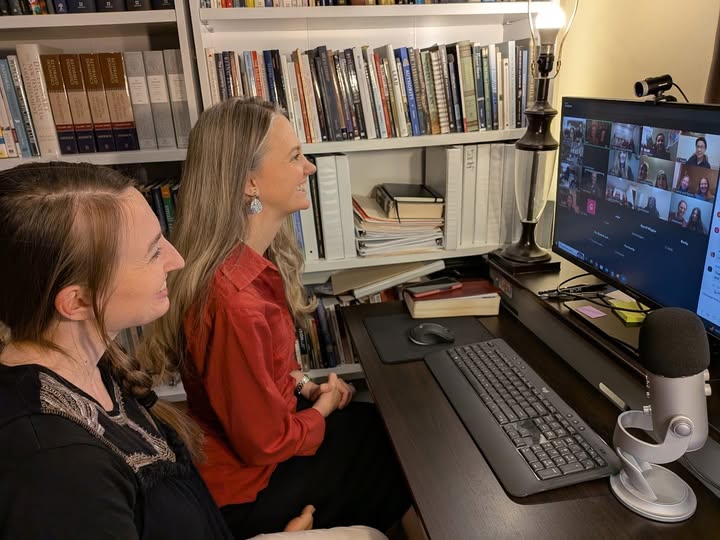
- “My favorite part was getting to participate in the live Zoom session with Sarah and Grace!”
- “I was able to talk to my mother about things I greatly struggle with, and I have been most helped and encouraged by her advice, and by no longer hiding it in my heart.”
- “I recommitted myself to the Lord as a result of the conference.”
- “I really enjoyed the skit about the mountain climb and its relevance to struggles in our lives.”
- “[It] gave us uninterrupted time together to focus on things that matter.”
- “The girls expressed that the skit about the media and the girls on their phone spoke to them greatly, because that is exactly what happens to them: comparison, discouragement, believing lies, etc.”
- “Love the scriptures and the practical steps to help us grow in our relationship with the Lord.”

- How do I know if my faith is enough (to get to heaven)?
- What suggestions do you have for reading the Bible consistently?
- What Christian biographies do you recommend?
- As a single woman, how do I pursue a career to support myself and not lose sight of undivided attention to Christ?
- How can I encourage my younger siblings?
My Prayer Target (by Sarah Hancock)
When I was growing up, there was an elderly couple who lived next door to us. Sometimes they would babysit their granddaughter, Karen, who was about my age. I liked it when she visited her grandparents because she was a kind friend and a lot of fun to play with. We would climb trees, and play games. I don’t remember ever sharing the gospel with her, but she knew I was a Christian, and I made a few spiritual comments to her when we were kids. After we entered our teen years, Karen and I didn’t see each other much anymore.
When I was about 18, I decided to choose a person to specifically pray for when I was distracted by something (such as when I was thinking too much about a guy, growing discontent, or wasting my time daydreaming). I decided to choose Karen, my childhood friend. I called her my “prayer target.” 🙂
I began to pray regularly for Karen’s salvation. When my mind started to dwell on something I didn’t want to focus on, I would choose to pray for her instead.
Years went by, and I didn’t see her or hear from her. I eventually moved on to other prayer requests. Then one day when I was in my twenties, my mom told me that she had run into Karen and that she had become a Christian!
When Karen was in college, some Christian friends invited her to a Bible study where she encountered true believers who really loved Jesus. She understood the gospel for the first time, and she trusted in the Lord as her Savior. She began going regularly to a Bible believing church, married a Christian man, and had two children whom she decided to homeschool. When Karen’s daughter, Katelynn, turned 10, she started coming to my Bright Lights group, and it’s been a blessing to watch her grow in the Lord as well.
I’m so thankful the Lord led me to pray for Karen, and gave me the privilege of being a part of her story! It encourages me to keep praying even when I don’t see results.
The truth is that we often don’t get to see results to our prayers in this lifetime. Prayer takes time and energy. It’s a spiritual battle. It’s hard. It requires faith. We all need encouragement to persevere in prayer. I hope this story provides some extra encouragement to you today. God is working in the world today, but the battle is raging. Perhaps you also would want to choose one person as a specific prayer target for the upcoming year. May we as God’s people pray, pray, pray!
Here’s a picture of Katelynn, Karen, and me. 🙂

When Our Neighbor Encountered the Gospel of John (by Harold Mally)
|
|

From Agnostic to Open Heart (by Grace Moffitt)
|
|

|
|

|
Abound Still More 2025

Our Abound Still More women’s conference at the Ark Encounter in Kentucky went so well!

We had an amazing team of women who helped as leaders. They served so joyfully as they helped plan, prepare, and serve the ladies at the conference. They led music, shared testimonies, led small group discussions, decorated, set up the book table… you name it! They were a huge blessing to everyone!

Sarah and Andrew spoke together for two of the sessions. They talked about the joys and complexities of being single in today’s society and church. They shared encouragements and stories from their lives when they were single. They also talked about singleness in the storyline of Scripture and the positive crescendo we see in God’s plan.
The women were a very attentive audience and were truly there to learn and grow. Here are a few comments we received:

“I was feeling impatient and irritated by my singleness right before the conference, lol. Through this conference, the Lord helped me to see my singleness as a gift and opportunity – from Him. I appreciate singleness much more and actually went home excited about it! I was also struggling with a particular temptation in my life, and Nickie’s talk was really helpful for me. It was what I needed to hear. :)”
“The session on abounding in Christ was amazing, the stories of discipleship that were shared were incredible, the tips on prayer life was great! I loved it all!”
“It was an amazing blessing to my sister and me. We made some great friends, and … He gave us such good discussions that really uplifted and encouraged us.”
“I am already implementing changes! It was also so encouraging to be in a room full of other single ladies some of them even older than I am! It reassures me that my standards are not too high, there’s not something wrong with me, I don’t need to try harder…we are all just holding out for the one God has for us if he even has marriage for us at all!”
Caitlin Clark (By Sarah Hancock)
|

|
|

|
High School Guys with Zeal for God (By Harold Mally)
|
|

Rebuilding Relationships with Children (By Harold and Rebekah Mally)
Recently, we received a question from a mother who has a strained relationship with her adult children. She asked: “Any thoughts on how to build bridges, when older children really don’t want to have anything to do with us?”
We have received similar questions from other families over the years. We thought we’d share our thoughts for this mom as our newsletter article this month because we believe there are certain parenting mistakes that can be avoided, making estranged children much less likely.
Rebuilding relationships takes much prayer and humility. Often bitterness has taken root, and only the Lord can bring healing. We would encourage parents to humbly seek the Lord and ask Him to show them any specific ways they have hurt or failed their children, whether intentionally or unintentionally.
- We would suggest that parents prayerfully make a list of every offense they can remember – everything they did wrong and each specific event or situation. It could be times they were too harsh, punished unjustly, got angry, spoke unkind words, neglected needs, or acted in pride. They should even try to think back to the beginning, to the very youngest ages. Bitterness toward parents can begin very early in a child’s heart. Parents should also list what they should have done differently, if they know.
- Then parents should arrange a talk with each of their kids, probably one on one. We would suggest some time in prayer and fasting first. Maybe even a lengthy fast of one to three days. When this difficult talk occurs, parents must be utterly humble. They should ask forgiveness for ways they have failed as parents, absorb ALL the blame, and express true repentance. When expressing repentance, it is important for parents to be able to explain what their offense was, how it hurt their kids, and even how their kids must have felt. If parents are not able to express this, their kids will not believe that their parents truly understand.
- This is a hard assignment for both the parents and their children. Healing offenses takes courage, but mostly humility. Parents must listen and not be defensive. They should not give any explanation to justify themselves. They should simply acknowledge that they were wrong. And they should not expect any immediate response from their kids because forgiveness is just as hard as repentance and can take time to process.
This is not meant to be a formula, but an example of how humility may look in this situation. Great humility is the key!
Frequently, when we are asked for counsel in a situation like this, we find (or at least it’s our strong opinion) that the parents have been too strict. Not necessarily harsh, just strict. Too many rules. Too much oversight. Micromanagers. (Of course, parents must protect and apply some limitations, but it should be done in a way that children understand and that focuses on the heart, not just the external actions.) When parents are their kids’ allies and best friends, the kids are willing to cooperate and agree that parents know best. But when the parents try to control through rules, the kids feel forced and become resentful.
Actually, it’s a little more complicated than that. Usually, one of the problems is that the parents don’t trust the kids, and that is the reason for all the rules. But it’s even deeper than that. Often the reason the kids aren’t trustworthy is because they have no desire to please their parents. And it gets deeper still. The reason they don’t desire to please the parents is often because they can’t. That is, the parents are never pleased (or at least the kids don’t feel that their parents are pleased). The parents seldom praise, but rather scrutinize everything. It’s difficult for the kids to be successful, so they stop trying. They soon see their parents as foes instead of friends.
All this usually starts at the youngest ages. Parenting requires gentle, loving teaching. As much as possible, parents need to see everything their kids do as wonderful. When the child misbehaves, the parents need to learn to see the various factors affecting the behavior – tiredness, pain, disappointment, etc. This will help the parents to be compassionate. Parents need to be an ally taking the child’s side. It’s human nature to like those who like you. This will be true for children as well. Of course, parents love their children, but children need to know that their parents really like them too. Parents must be their kids’ best friends and praise them as much as they can. Pleasing one’s parents is success for a child. Praise gives them this success.
Malachi 4:6 is a familiar verse about fathers and children. “And He will turn the hearts of fathers to their children and the hearts of children to their fathers.” Something about this verse that strikes us as significant is the order. First, the hearts of the fathers are turned to the children. Then, mentioned second (and I wonder if that means as a response), the hearts of the children are turned to the fathers. Whether that is the primary intended meaning of the verse or not, it nevertheless seems to us to be a true principle.
The buck stops with us as parents. We must assume responsibility. When we fail, we must be utterly humble. Meditate on how Christ has given you grace and modeled humility. Ask for God’s forgiveness and a fresh appreciation of grace in Christ!
“God resists the proud, but gives grace to the humble” (Jas. 4:6).
The most important thing we can do for our struggling children is to pray! The Prodigal Prayer Guide, written by parents of prodigals and former prodigals, is a resource we recommend to help your prayers be rooted in God’s Word. Remember, there is always hope! “With God all things are possible” (Matt. 19:26).
This article was written in our newsletter. You can sign up for the monthly newsletters here
Quan (By Harold Mally)
|

|
“Me Ye Have Not Always” (By Harold Mally – with Rebekah Mally)
Jesus reprimanded the disciples who criticized Mary when she anointed Him shortly before the crucifixion, because they said that this expensive ointment could have been sold and given to the poor. He said, “Ye have the poor with you always, but Me ye have not always” (Mark 14:3-7).
There is a principle in this. There are other things we “have not always.” I don’t want to avoid the main teaching of this verse which is our dedication to the Lord Jesus Christ. But I think it is helpful to encourage parents to apply this same principle to their children. Them we “have not always.” They grow up!
I need to point out that the important factor isn’t that we as parents no longer have the joy of these little ones running around our feet. That’s true, but not the main issue. The main concern is to teach, nurture, and invest during these young “run around our feet” years. Now is the time to invest, because “them we have not always.”
How should we invest in our children? I asked my wife this question and she rattled off this list faster than I could type.
- Incorporate them in everything you do and explain why and how you are doing it. In this way they learn how you think and why.
- Encourage them as often as you can. Be generous with your praise, letting them know how great they are doing. They need to know that you think they are the best kids in the world.
- As parents, talk highly about your kids to each other in their hearing. It’s important for them to know that their parents are pleased with them.
- Have a daily routine of being in God’s Word together as a family.
- Talk about God’s Word as part of your daily life. Share with them the things God is teaching you and how He has answered prayers.
- Be a good listener. Parents need to know what their kids are thinking and how they feel. Ask questions and listen. Explain but don’t lecture.
- Enjoy being with them. Consider them as your best friends and realize they need you as their best friend.
- Help them to develop their own convictions by explaining why your family makes specific decisions. Help them learn to discern between good and evil, and to see the consequences of sin or worldliness. This is one of the best ways to protect.
- Be willing to be humble and ask forgiveness when there is misunderstanding or friction, even if it is mostly the kid’s fault. It’s good when parents can absorb as much blame as possible. Parents must be the ones to show maturity.
- Remind them that the ultimate goal is to please God. Pray that they will be motivated, not by rules, but by a desire to please you and their Heavenly Father.
- If there is a problem between your child and someone else, take your child’s side as much as possible. You need to be their ally not their foe.
- Look for ways to expose them to godly influences through friendships, books, conferences, and hospitality.
- Let them see that your priority is to serve the Lord, and plan ministry things you can do together.
I’m sure each of you could add many more ideas to this list. Investing in our children takes time, intentionality, and much prayer. May the Lord give you wisdom and grace as you raise up the little ones in your care, making the most of each day because they grow up fast.
“Only take care, and keep your soul diligently, lest you forget the things that your eyes have seen, and lest they depart from your heart all the days of your life. Make them known to your children and your children’s children” (Deut. 4:9).
This article was written in our newsletter. You can sign up for the monthly newsletters here